Episode Description
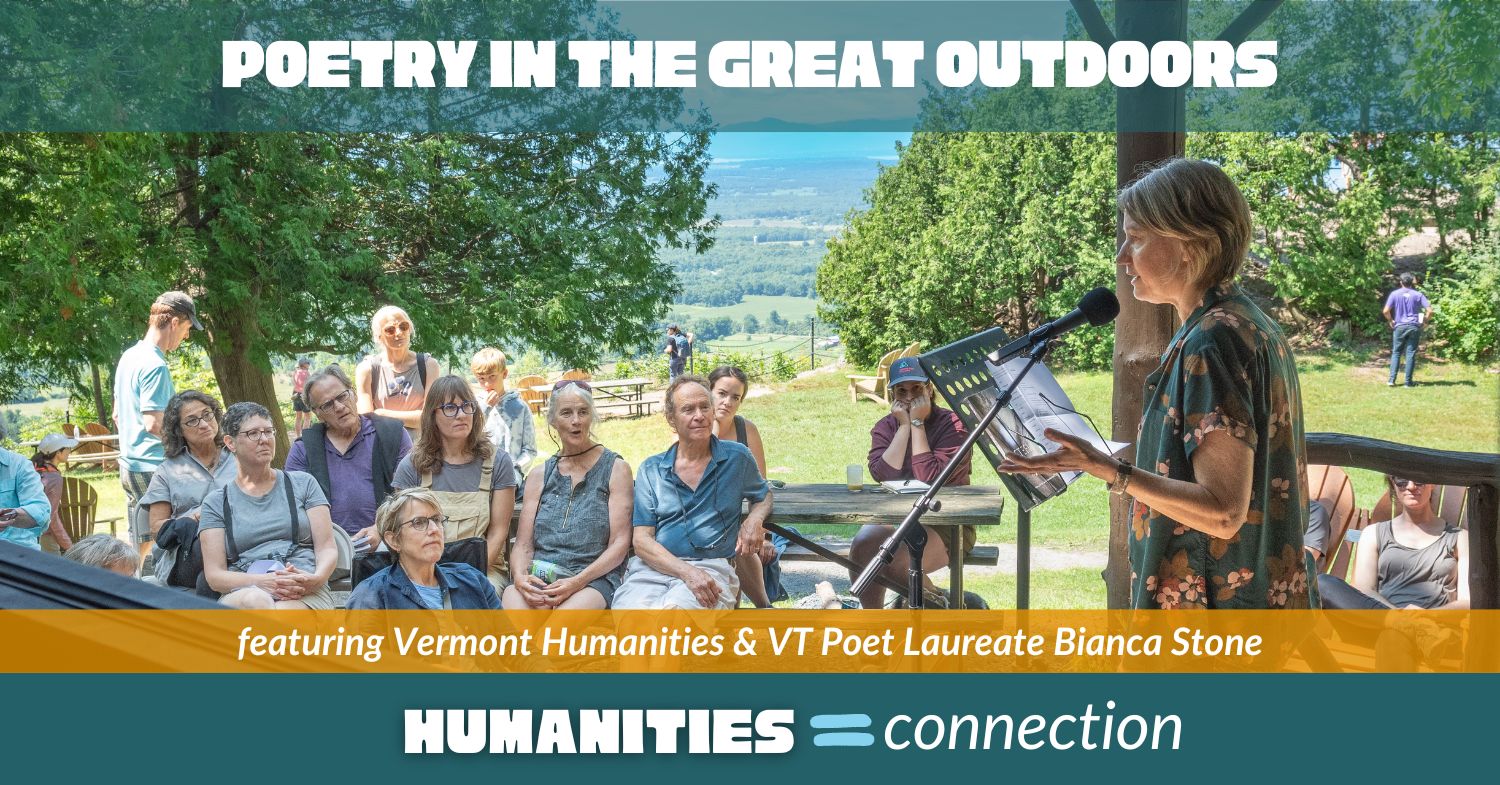
Does reading poetry make the world a better place? Are poetry readings better in the great outdoors? Every summer, Vermont Humanities hold a series of poetry readings in Vermont state parks called Words in the Woods, which connects participants with the state’s natural resources and its living literary legacy. Dive into the relevance of poetry in our modern world, the relationship between nature and poetry, and the importance of supporting living poets in this conversation featuring Jacob Pelletier, Community Programs Officer at Vermont Humanities, and Bianca Stone, Vermont Poet Laureate (and past Words in the Woods speaker).
Listen
Humanities = is available on all major podcast platforms. Listen on your browser by using the player above or find your preferred platform here.
Guests

Bianca Stone
Vermont Poet Laureate
Bianca Stone is a Vermont-based poet and scholar currently serving as Vermont’s poet laureate. Stone is the author of many books, including the poetry collections What is Otherwise Infinite which received the 2022 Vermont Book Award, and The Near and Distant World. Her poetry and writings have appeared widely. In 2013 she co-founded the poetry-based nonprofit, Ruth Stone House. She hosts the Ode & Psyche Podcast.

Jacob Pelletier
Vermont Humanities
Jacob Pelletier is the Community Programs Officer a Vermont Humanities. Previously, Jacob was the Assistant Director of Alumni Engagement at St. Michael’s College in Colchester. He served three years in the Peace Corps in Paraguay. He holds a BA in Political Science, Sociology Anthropology as well as a Masters in Teaching English to Speakers of Other Languages from St. Michael’s College.
Show Notes/Learn More
A statewide nonprofit organization founded in 1974, Vermont Humanities seeks to engage all Vermonters in the world of ideas, foster a culture of thoughtfulness, and inspire a lifelong love of reading and learning. Vermont Humanities believes that engagement with the world of ideas, in interaction with others, contributes uniquely to richer lives, stronger communities, a more humane society, and a better world. Their seasonal “Words in the Woods” program allows Vermonters and visitors to enjoy their state’s natural beauty while listening to and reading literature in the outdoors.
Bianca Stone website + Read Bianca Stone poems (On the podcast, Bianca reads “Nature.”)
Vermont Book Awards (list of past winners)
Further Reading/Watching/Listening
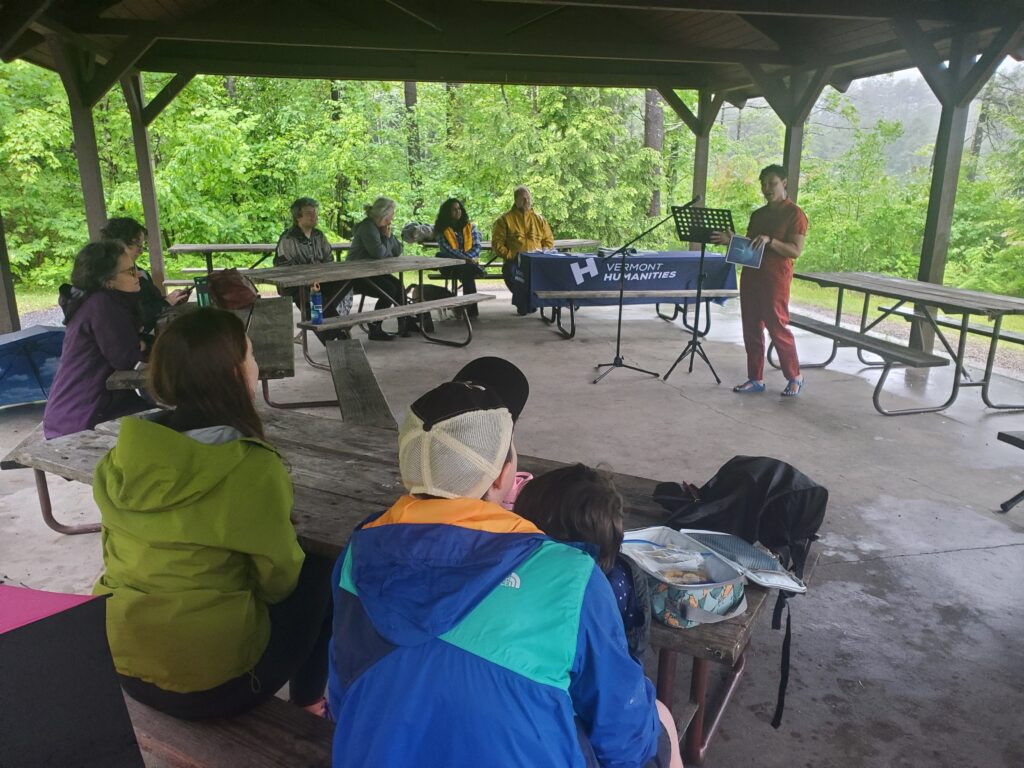
A Words in the Woods event with poet Adrie Kusserow at Groton Nature Center.

Groton Nature Center, a Words in the Woods location.

A Words in the Woods event with poet Rage Hezekiah.
What are Humanities Councils?
Our nation’s 56 state and jurisdictional humanities councils are nonpartisan 501(c)3 nonprofit organizations established in 1971 by Congress to make outstanding public humanities programming accessible to everyday Americans. Councils are funded in part by the National Endowment for the Humanities (NEH) and connected by their national membership association, the Federation of State Humanities Councils.
Episode Transcript
Read Episode Transcript
Hannah Hethmon (Narration): You’re listening to Humanities =, a podcast about real individuals, organizations, and communities making a real difference through the humanities.
I’m your host, Hannah Hethmon.
Humanities = is a production of the Federation of State Humanities Councils.
If you need a bit of inspiration or a reminder to slow down, reconnect with your humanity, and look closely at the beauty all around us…then I think you’ll enjoy this episode.
Vermont Humanities runs a series of poetry readings in state parks called Words in the Woods, which connects participants with the state’s natural resources and its living literary legacy. To learn more about the program and how poetry can make life better, I talked to Programs Officer at Vermont Humanities and one of the poets from their Words in the Woods series. I’ll let them introduce themselves.
Jacob Pelletier:
No problem. So, my name is Jacob Pelletier and I’m a community programs officer with Vermont Humanities. I do a lot with our visiting speakers and scholars program. So, bringing authors and other speakers to schools and libraries and historical societies across the state. And one of the programs I’m lucky enough to organize is our words in the woods with our poetry series each summer.
Bianca Stone:
It does sound better, Jacob. I’m Bianca Stone. I am a poet. I am the current Poet Laureate of Vermont. work. I’m a visiting professor at Dartmouth, and I also teach at Bennington College.
Primarily though, I run the literary nonprofit, the Ruth Stone House with my husband, the poet Ben Pease. And we’re a hub for poetry retreats, classes, letterpress arts, and events—all geared towards conversations around poetry and poetics. yeah. And I, you know, as a poet, of course my main thing is writing poems and publishing poetry books.
Hannah Hethmon:
Great. So, Bianca, this podcast is about making a difference, people making a difference through the humanities. So, speaking to the unconverted or the ambivalent, why poetry? Why does it matter? Why does it make our lives better? Why should we read it, write it, and share it with others?
Bianca:
Yeah, I think poetry, it can be very intense format to surrender yourself to. And it takes a lot of time sometimes to figure out what is or how to read a poem. Right. But the joy of reading poetry, once you stumble into it, you just become so more open to understanding the ways in which consciousness works, the way in which humans communicate with one another and don’t communicate with one another, the ways in which we sort of ask the big questions about what it means to be in this world and be part of even the ecosystem itself. Poetry has always been deeply involved with the natural landscape.
So, I love to talk about poetry being important to read because it brings us into a kind of right relation with one another and with the world around us and it doesn’t pretend to answer questions it. It asks questions that are unanswerable. it attempts to answer questions that are unanswerable. And I think that we really don’t have a lot of places to have those kinds of strange conversations. And it’s really, it’s also beautiful and musically enjoyable. I think, and there’s so many different kinds of poetry, right?
So, when people say, I don’t understand poetry, I don’t like poetry, I think, well, it’s just as varied as different musical genres, as different kinds of ways of painting, as different as people are, right? So, you get to investigate what kind of person you are when you investigate which kind of poetry you like. And then you find people who, for some reason, you feel seen by those poems and then you’re like, you feel more seen as a person. So, it makes you feel better about humanity, I guess, maybe.
Hannah:
Yeah, I think I like sort of practical and silly poetry. I like poetry that tells a story. I’m a medievalist, know, sagas and tales like that, but also like Billy Collins, like a little just a little silly. And I think that reflects me as a person.
So, Jacob, tell me about Words in the Woods. What is it and what is it like to attend? What could people expect?Where do you go?
Jacob:
Yeah, so Words in the Woods is our summer poetry series where we bring five to six poets into Vermont State Parks each year for free public poetry readings and discussions. And they’re always a lot of blast because each poet kind of shapes that poetry reading differently being in the unique state parks that they are.
We do this in partnership with the Vermont State Parks and the Vermont Arts Council. So, it’s a very collaborative process of showing how all of these things overlap, especially in Vermont. We see this kind of inspiration of the nature and poetry and of the other arts in Vermont as a huge legacy with not only the poets, but artists across the different fields.
And what’s really fun about this program is we’re bringing people into a unique space. So, we provide the park entrance fee for all participants that joined the program. And then they get to hang out and not only hear from our local poets and their work—a lot of them do use this platform to workshop some of their things as well, which is really great—but also explore the parks afterwards. So, it’s a really great kind of combination of getting people access to these poets and seeing that it’s happening right now in their backyards, but also seeing these new unique parts of the state where they may not have traveled before to kind of see what the state park system has. And I’d be remiss if I didn’t mention that a lot of this was inspired by the Indiana Humanities Campfires programs where they do a lot of outdoor activities with their parks too.
Hannah:
Bianca, tell me about your Words in the Woods event. Where did you read? What was it like? How did you choose what poems to read out in nature?
Bianca:
I loved my Words in the Woods event because it was at Lake Dunmore where I’ve been going my entire life and my family has been going before me. And so, it felt really good to be in that little weather shelter on the beach and to read poems. Awkward a little bit in the most delightful way to be reading poems at the family beach. There was this intimate group of people and they were so attentive and so excited to hear poems, and that’s all one can ask for at a reading and to hear people laughing and talking and swimming and have that as a sort of background was really delightful. And it was easy for me to choose poems because it ends up, of course, that so many of my poems have the landscape of Vermont in them.
So, it’s this really meta event to be outside, writing about and talking about the mountains with the mountains behind you. So, you get to talk about the exterior world while also talking about the interior world, while being outside. So, I really loved that. I remember I remember just having such good conversations with people after the reading too. Like I read poems and then we talked afterwards and we had a Q &A, and that’s one of my favorite parts actually is like letting the poems have their space and then engaging in this conversation, having us all share this place together, you know the place of Vermont and this place that’s reserved for being outside and appreciating the landscape of Vermont, and then talking about what it means to write poetry in these places and about these places and with one another. So, it’s just, it’s such an awesome program.
Hannah:
Even though there is a lot of nature and landscape in so many poems, getting out in the great outdoors and reading literature are often seen as sort of married different activities, maybe even for different types of people. So, what do you think bringing them together?
Jacob:
Yeah, I’ve thought about this a lot, and it really is all about kind of building those connections, right? Like I always think of kind of like Walt Whitman with the “We contain multitudes” segment, right? Where, people can enjoy poetry and be really sporty and outdoorsy and maybe find those deeper connections with the hiking trails and the places they are through these types of programs. But not only the connections with our state, but also with each other. And I think that’s something more and more we need these days is really finding those commonalities and also being willing to explore those things.
Like maybe I am not a big poetry lover, but I love the state parks. So maybe this is a new way that I can experience the state parks and connect with my other participants and other Vermonters who are really just trying to build that connection and build that community and show that we care not only about our poets and our legacy of poetry, but also about the parks in the state that we live in.
Hannah:
Yeah, I guess, you know, an event like this, it’s a way for people to maybe challenge themselves in one direction or the other, getting out in nature, reading poetry, while also becoming a little more rooted in place. I know for me, after the pandemic, I just wanted to feel more connected to like the place I was from, to put down roots, so having that sense that this is a Vermont poet, this is a Vermont park, you are here, you are part of this legacy. I can see how that would be a really nice benefit for people.
Jacob:
Yeah, it’s been really fun to kind of see event kind of take a life of their own when they go to these events. Like we have some people that kind of travel the state with us each summer to see multiple events. And we always try to do these locations across the state to provide that sense of access where we’re not always in the Burlington area or we’re not always in Southern Vermont. We try to spread these out so folks really can get a taste for what we have to offer. And it’s been a lot of fun to kind of see those folks and build those familiar faces and connections over the years.
Bianca:
Yeah, it’s almost like a gesture in honor of each being absent from the other. What I mean by that is like when I’m walking in the woods, I’m sort of priming myself to go writeright when I get home. And I’m not doing the writing when I’m in the woods necessarily or doing the reading when I’m in the woods, but it sort of lays the groundwork for the mind to really be able to create and engage with writing and vice versa, right? So, we read and then we crave to be outside without language, without words and to just be in the world and look at the world. And that’s so important for our language mechanisms and consciousness itself.
We have this thing called language, you know. In some ways it separates us from the natural landscape and from the animals and from the inert. And at the same time, when we go into the woods and we sing our songs, we sing our ballads, we find our place again in nature, I think. And I love that. You know, it feels right. This is what people did in the beginning when the first poems were written. They gathered in the woods together and they read their poems out loud the breath of the poems mimicked the breath of the body, but they also mimicked the birds and the rivers and the sounds of the wind and the trees and all those things. yeah, it’s again, a rare, a rarer thing in our culture and world today, and we should encourage it whenever we can.
It’s like, wow, I can read poetry in the woods? You know, shouldn’t it be in a dark ball or like a library or an auditorium? No, it’s like, when you get out there, feels, it feels different, but in some ways it feels like it’s where it should be.
Hannah:
Yeah, and that act of reading aloud to other people, telling stories in poems that are easier to remember and memorize, I mean that predates writing, predates all our…certainly the printing press. I don’t know if it predates bars because there’s always somewhere to drink.
Bianca:
Yeah, maybe bars and poetry emerge simultaneously.
Hannah:
Jacob, why does Vermont Humanities care if people engage with poetry and living poets? You know, you have limited resources and a lot of cool projects to put money into. Why is this something that you keep investing time and money in?
Jacob:
I mean, it’s kind of like the big question of our age, right? As we’re seeing kind of the arts and humanities have struggled with funding opportunities and being just kind of supported by communities. For me, I think what you mentioned there is the importance of living poets, right? Like poetry is always evolving and it’s not kind of just the metered Shakespeare stuff we think about a lot of the times with poetry. It’s really this art form that’s alive and adapting to where we are as a community and where we are as individuals as well. It’s capturing this essence of an experience or questioning a current event or topic to give us a really concrete snapshot and perspective.
Because that’s what I think poetry really offers in this time is really giving this unique, very quick, very detailed perspective about a topic or an event and or even an emotion of how we’re reacting to different things. And these are all ideas that humans have been wrestling with for eternity. And poetry gives us the chance to really put that into words and to ask to look from those different and unique perspectives, but also connect ourselves with what we’re experiencing all together in these poetry readings at that time.
Hannah:
I love that. I’m gonna put you a little bit on the spot if people listening want to get into more Vermont poetry. Where would you set, what should they read? What should they look into?
Jacob:
Yeah, I mean, I’m always looking for new poets, and that’s kind of like the beauty of doing this program. Some people that we’ve partnered with, like the Vermont Arts Council, often highlights new and unique poets. Sundog Poetry is also an organization that we’ve partnered with. They actually received a grant from us for our fall festival program really exploring kind of the connections between the ecology and eco politics and poetry. So, there’s a lot of cool stuff kind of overlapping poetry with modern society and modern roles. I’d also, you know, I have to recommend Bianca Stone and her work and all the other poets that have kind of come in through the Vermont Book Awards program. Because that’s another thing we highlight through this program are some of the Vermont Book Award nominees for their poetry books and poetry collections. So, if you haven’t checked out that, that’s a huge lists of folks that are all incredible writers and very talented and we’re lucky to have worked with them through this program too.
Hannah:
Bianca, were you able to share one of your poems that you read at the event or another poem just to give people a sense of what it was like to sit and hear you talk, even though we are indoors, but we’ll imagine.
Bianca:
Yeah, absolutely. Let me see…it’s hiding from me in my own book. Page 11, page 11. Please turn to page 11. “Nature.”
[Reading from the poem, “Nature.”]
Maybe humans are the failed A.I. of Nature.
Maybe Nature made something it thought would tend the garden.
Maybe Nature made something sexy, to watch
clean the pools with long butterfly nets
and a sunburn—the retainers of Nature.
Now, mirror of mercury and Hell, that hot-red bomb
in your mouth, that sweet battleground on your tongue—
it is the catastrophe of your mission.
The wealthy, with their outstanding educations
and custom shoes, and empty apartments
floating above like Glinda; the ballad of media,
the intellectuals, almost shepherding
evolution, but falling asleep in their haunted paintings
and unattainable poetry—all the dimensions
of each person’s being, punk, restless in a loop.
Sometimes I want to be taken into nothingness.
I want to be burned with the gypsy moths and bindweed.
Run to exhaustion with the wildebeest.
I don’t want this phone, I want to kill God.
Maybe humans are the complex systems
of a natural order that must build and destroy itself in perpetuity.
Blue chicory on the road saying the end of summer
in a sandstorm of our passing—they gyrate and smile—
what of our little duties to the architect?
Our deep-red blood, our lush tech—
Archangels, limping in paradise.
Hannah (Narration): Thanks for listening to Humanities =, a podcast from the Federation of State Humanities Councils. You can learn more about the humanities councils and programs in this podcast, see episode transcripts, and explore additional content on our website, statehumanities.org, that’s statehumanities.org.
Our nation’s 56 state and jurisdictional humanities councils are nonpartisan nonprofit organizations established in 1971 by Congress to make outstanding public humanities programming accessible to everyday Americans.
If you’d like to learn more about your humanities council or support their work through a donation, you can do so at statehumanities.org/directory or by searching your state name + “humanities council.”